THE IMPORTANCE OF MORINGA OLEIFERA TREE
INTRDUCTION:
Moringa Oleifera- Known as moringa in Tamil is the widely cultivated species of a mono-generic family, the moringaceae, which has fourteen species. Is native to the Sub-Himalayan tracks of India, Pakistan, Bangladesh and Afghanistan. The plant is commonly known as Horseradish tree/drumstick tree/Ben oil tree, and locally known as “Sahjna” in Urdu, “Zogalegandi” in Hausa, “Eweigbale” in Yoruba, and “Okweoyibo” in Igbo. It is a beautiful ornamental softwood tree with timber of low quality,usually grows 10-12m, with a spreading open Crown of drooping, brittle branches, feathery foliage of tri-pinnate leaves. The bark is grey and thick looking like cork peeling in patches. Flowers are yellowish white or cream colored; the pods are triangular in cross-section 20-50cm long containing up to 26 oily black/dark brown winged seeds. India is the largest producer of moringa with an annual production of 1.1 to 1.3 million tons of tender fruits from an area of 380 KM2.
Other species of moringa include; Arborea, concanensis, Borziana, Drouhardii, hildebrandtii, longituba, ovalifolia, peregrine, pygmaea, Rivae, Ruspotiana, stenopetala.
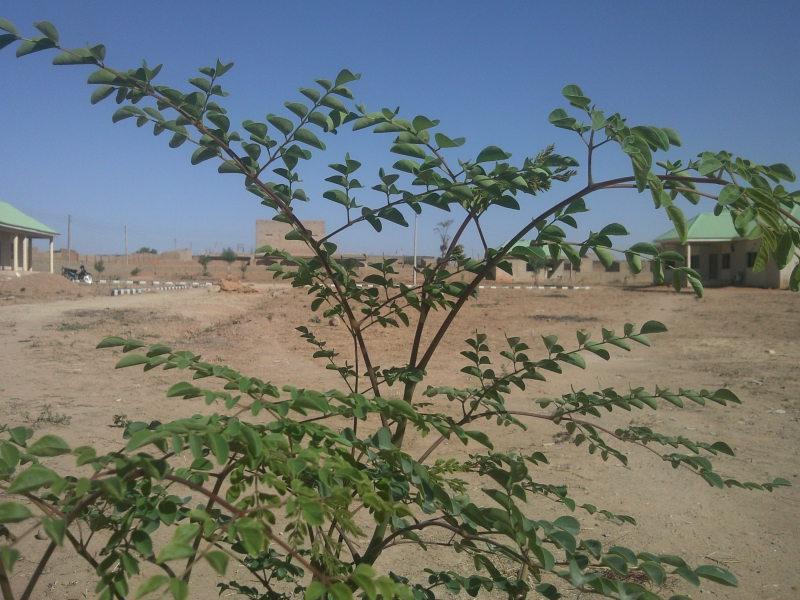
MORINGA OLAFIERA TREE
LITERATURE:
Nutritional Value: All parts of moringa tree are edible and have long been consumed by humans. It’s a versatile medicinal plant having variety of medicinal uses and high nutritional value. It has been used to combat malnutrition especially in children and nursing mothers.
The leaves contain more Vitamin A than carrots, more Calcium than milk, more Iron than spinach, more vitamin C than Oranges and more potassium than Bananas. And that the protein contents or quality of leaves are matched that of milk and egg. The seed oil which is rich in oleic acid, like olive oil is valuable cooking oil, that never become rancid.
It is also, of remarkable interest that, the dried Moringa leaves have high deposits of mineral elements as compared in the table below;
|
Fresh Leaves |
Dried Leaves Powder |
|
4 times Vitamin A of Carrots |
10 times Vitamin A of Carrots |
|
7 times Vitamin C of Oranges |
½ times Vitamin C of Oranges |
|
4 times Calcium of milk |
17 times calcium of Milk |
|
3 times Potassium of bananas |
15 times Potassium of Bananas |
|
¾ times Iron of Spinach |
25 times Iron of Spinach |
|
2 times Protein of yoghourt |
9 times Protein of yoghourt |
Hence, drying should be done Indoors and the leaf powder stored in opaque, well seal plastic container since sunlight will destroy Vitamin A.
The presence of essential nutrients and minerals in moringa leaves imply they could be utilized to improve growth performance and health status of poultry and animal fodder in general. Since, the level of anti- nutrients detected in the leaves appeared very low. But, soaking of plant materials or boiling in water is said to reduce toxic effects and improves utilization in terms of feed intake and protein digestability.
Phytochemistry:
Moringa Oleifera is highly reputed in folklore and traditional system of medicine as a remedy for variety of ailments. In India and Indo-china, the roots are regarded as antiscorbutic and rubefacient, being applied externally in the form of a plaster as a counterirritant. The juice of the root with Milk is also useful as a decoction in hiccoughs, asthma, gout, lumbago, rheumatism and enlarged spleen or liver.
Plant based anti-microbials have enormous therapeutic potentials as they can serve the purpose with lesser side effects that are often associated with synthetic anti-microbial.
However, phytochemical Investigation on the Moringa oleifera plant revealed the presence of Moringine and moringinine alkaloids in the root; pterygospermine alkaloid in the flower, fatty acids and fixed oils in the seed. The moringa species gave rise to compounds containing simple sugar, rhamnose and it is rich in a fairy group of compounds called glucosinolates and isothiocyanates which have hypotensive, anti- cancer and anti- bacterial activity. Extracts from moringaoleifera and termitomyces have been used as nutriceuticals to boost immunity in HIV/AIDS patients.
General Uses and Applications:
Moringa Oleifera tree was called a multi-purpose tree or a miracle tree due to its uses in various aspect of life as follows;
Leaves: leaves are used the most among the tree products. The leaves are low in fats and carbohydrates and rich in minerals, Iron and Vitamin B. it is particularly useful as a human food by boiling or steam cooked, and add condiments. It can also, be used in the same way as spinach. Crushed leaves are used to clean cooking utensils.
Flowers: Flower juice improves the quality flow of mother’s milk when breast feeding. And it can be cooked and mixed with other foods or fried in batter.
Pods: Pods can be used in soups and stews. They can be cooked like other green beans and have a similar flavor to asparagus. And if eaten raw act as a De-wormer.
Roots: A sauce similar to horseradish sauce can be made when the seedlings is only 60cm tall.
Gum: The gum that is found in the bark can be used to season food.
Seeds: The seed powder joins with the solids in the water and sinks to the bottom. This treatment removes 90-99% of bacteria contained in water, it replaces Aluminium Sulphates. 20L of turbid water can be treated as follows;
- Remove the wings and brown seed coat and discard any seed kernels that have dark spots or any other signs of damage.
- Pound the kernel to a fine powder
- Add 2g or 2 teaspoon of powder to one cup of clean water, pour into a bottle and shake for 5 minutes.
- Filter the solution through clean cloth to the bucket of dirty water
- Leave it for one hour
- Filter and boil before drinking.
Moringa stenopetala Seed is better than Moringa Oleifera in terms of water treatment. The Moringa seed powder is used for heavy metal remediation. Thus, the Successful biosorption of heavy Metals by Moringa as a potential heavy metal removing agent is attributable to its Oxygen and Nitrogen donating Carboxylate and Amino groups.
The Seed powder can be pressed for oil extraction. If a press is not available, the seeds can be browned or roasted, ground, added to boiling water and the oil floats to the surface. The Seed contain 35% oil and this is used for cooking purposes. The oil does not turn rancid and also, burns without smoke. The Seed cake use as good fertilizer.
References:
1- Ogbe,A. O and John P. Affiku (2012): “proximate study, mineral and anti- nutrient composition of Moringa leaves Harvested from lafia, Nigeria; potential benefits in poultry nutrition and Health. J. of Microbiology and Biotechnology and food science. 1(3)pp 296-308.
2- Aminu A. Ambi et al (2001): toxicity evaluation of Moringa Oleifera leaves; International journal of pharmaceutical research and innovation, vol. 4. Pp 22-24.
3- Patrick J. masika et al (2011): Nutritional characterization of moringaoleifera leaves, African journal of biotechnology. Vol. 10(60),pp 12925-12933.
4- Kenneth Anchangyongabi : the role of phytobiotechnology in public health. Biotechnoly-vol. xi- phytobiotech research foundation and clinic Bamenda, Cameroon.
5- Melanie Broin ; the nutritional value of Moringa Oleifera leaves. Moringa news network. Melanie.broin@wangdoo.fr
6- Tamannatalreja (2010): Screening of crude extracts of flavonoids of Moringa Oleifera against bacterial and fungal pathogen. J. of phytology 2(11) pp31-35.
7- Suaibluqman et al (2012): Experimental assessment of Moringa Oleifera leaf and fruit for its anti-stress,Antioxidant and scavenging potential using in vitro and in vivo assays. Evidence- based complementary and alternative medicine Vol. 2012. Doi: 10, 1155/2012/519084.
8- Jed .W. Fahey (2005): Moringa Oleifera: A review of the medical evidence for its nutritional, therapeutic and prophylactic properties part One. Trees for life journal 1:5
9- HDRA- the organic organization: Moringa Oleifera a multipurpose Tree.
10- SantraS.C :eviscentre of environmental biotechnology, Dept. of environmental Science, university of kalyani, 741235, nadia west Bengal India. www.kuenvbiotech.org.
11- Info@dolcas-biotech.com: 2006-2008 dolcas-Biotech LLC.
12- Roloff A. et al (2009): Enzyklopadie der Holzgewachse, handbuch und atlas der dendrologie. Wiley-VCA verlag GmbH and co. KGaA. Weinheim.
For inforrmation contact us @biodeckatsina@yahoo,com
